Europe has some amazing winter resorts. Most people automatically head to the Alps, but it’s absolutely worth keeping an open mind for other mountain ranges, especially if you like things a bit more relaxed and authentic.
Enter the Pyrenees.
The Pyrenees offer a more rugged, wild-feeling alternative to the Alps, with smaller villages, friendlier price tags, and proper mountain character. You can ride powder in the morning and end the day soaking in thermal pools or lingering over a hearty dinner in a stone-built village.
Last summer I was already in the area and those rock formations really stunned me – not at all what I expected. So I was seriously looking forward to coming back in winter, checking out the pistes and conditions with a snowboard under my feet.
Here is an overview:
Why go? Authentic charm, generally lower prices than many big-name Alpine resorts, and the chance to experience different valleys and vibes in one trip.
Must do: Spend a day snowboarding or skiing the Pic du Midi area or Saint-Lary-Soulan, then unwind in one of the thermal baths that the region is famous for.
Pro tip: Renting a car makes it much easier to hop between valleys, ski areas and villages, but in winter you’ll want winter tyres or snow chains – mountain passes here can get properly snowy.
On this trip I rode the areas around Pic du Midi (Grand Tourmalet), plus Vallée du Louron, Saint-Lary-Soulan and Piau Engaly / Peyragudes.
If you want to plan your own route through the French Pyrenees, the official destination site pyrenees-holiday.com is a really useful hub for ideas, maps and current info.
Arrival in the French Pyrenees
Usually I pack my car and drive 8–9 hours into the Alps, with the whole car swallowed by snowboard gear. From my hometown to the Pyrenees, though, it would be closer to a 15-hour drive, so this time I went for the flight option. I flew into Toulouse, which is then roughly a 2-hour drive to a lot of the main ski valleys… much more realistic for a long weekend.
Next time, if I stay longer, I’d probably drive again, just for the flexibility.
It’s also worth checking if you can get a flight to Tarbes–Lourdes–Pyrénées Airport, which is closer to resorts like Grand Tourmalet and Saint-Lary than Toulouse. There’s also Altiport Peyresourde–Balestas (near Peyragudes), which is used for small aircraft and sometimes winter operations, but schedules are limited and very seasonal. Always double-check routes and availability for your dates.
And yes, there is that one “shitty airline” flying into some of these smaller airports – many people use it quite happily. I still avoid for good reasons. 😏
Image by CallumJelley, INTERSPORT.
Rental Gear
Instead of paying a heavy baggage fee to bring my own snowboard, I rented my entire setup at an Intersport shop in the resort – including boots. That meant I could travel with hand luggage only and still have everything I needed for a proper snowboard trip. I just clipped my helmet onto the outside of my small backpack and nobody minded. If they had, it would have become my “flight-security-helmet”. 😉
On my next trip I’ll bring my own boots. Rental boots were OKish, but with my own I know I get the exact grip and fit I like.
The rest? That’s up to Intersport, and I was very happy with the rental gear. The quality of rental skis and snowboards is top, and you’ll find Intersport shops in pretty much every major ski resort, often more than one. So getting gear is no issue, and prices are fair… 19 € per day for a weekend rental, is excellent value compared to airline baggage fees.
For reference, a 3‑day rental (snowboard + boots) cost:
- 56 € web price
- 53 € fidelity price
- 112 € in-store price
It’s roughly 14 € cheaper if you bring your own boots. Helmet rental would be around 12 € for three days. Prices do vary between shops and resorts, but it’s still generally cheaper than paying for bulky sports luggage on a flight.
You can browse options and book your gear ahead of time here: www.intersportrent.com
Intersport runs more than 750 ski hire shops across the Alps and Pyrenees, so you’re rarely far from a shop or rental counter in the bigger resorts. Renting on-site saves airline baggage fees, lightens what you haul through airports, and ensures you get freshly serviced skis or boards set up by people who do this all season.
You can normally swap equipment if conditions change (e.g., go from an all‑mountain board to something more freeride‑oriented, or from piste skis to something with more float). Many shops also have modern boot-fitting setups, including Boot Doctor scanners in selected locations, which help to match the right fitting boots to your feet.


Ski and Snowboard Luggage with Air France
For the ones who want to come with their own gear. Most probably you’ll get a flight with Air France and they treat ski and snowboard equipment as standard baggage, as long as it fits within your checked baggage allowance and you’re not on a “Light” fare. In practice that means: one pair of skis with poles and boots, or one snowboard with boots, in appropriate bags with a combined length under 300 cm. Boots can be in a separate bag, but ski/board bag plus boot bag count as one piece.
If you want extra bags or exceed size/weight, you pay extra options online or at the airport. Helmets in the cabin count as part of your hand luggage. ABS avalanche backpacks must be declared in advance and approved at least 48 hours before departure due to safety regulations. For the latest baggage rules and any changes, always double-check the current Air France Baggage Guide on their website before you fly.
Ski resort La Mongie and Pic du Midi
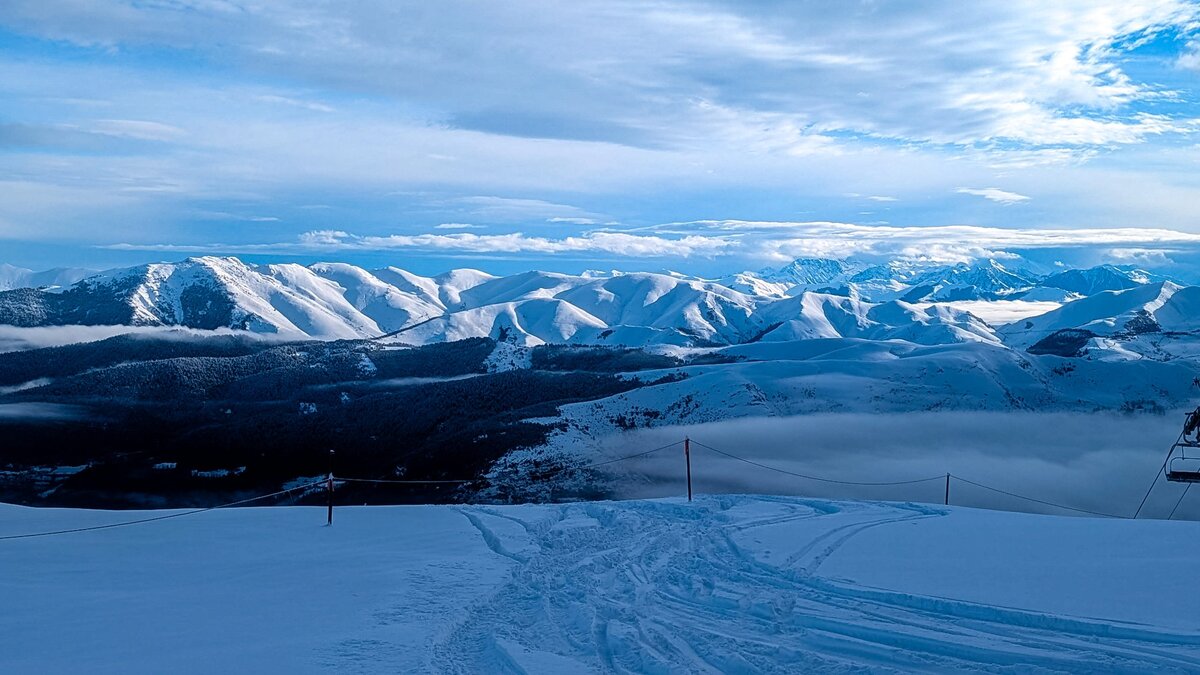
The first stop in the French Pyrenees was La Mongie. We arrived after dark, catching only silhouettes of the mountains around us. Waking up and pulling back the curtains is the magic moment on any mountain trip… and here it was just a sea of white, with mountains rolling off in every direction.

La Mongie is on the Grand Tourmalet domain, named after the famous Tourmalet pass from the Tour de France. The ski area links La Mongie on one side with Barèges on the other, giving a good mix of long groomers, wide pistes and more adventurous areas when the snow is right.
In the morning we grabbed our gear and hit most of the the pistes and also the one that run from La Mongie across into the wider Grand Tourmalet area. Around midday we took the cable car up to Pic du Midi, probably the most iconic summit in the French Pyrenees. This peak is home to an observatory, a museum area, a restaurant and a huge viewing terrace. On a clear day, you get serious, horizon‑filling views over Pyrenees ridgelines and far into Spain.
Inside the complex, there are exhibitions about the site’s history and astronomy, plus equipment like sun-tracking telescopes. It’s genuinely impressive how they built and maintain all of this on a high, exposed summit. The restaurant du Pic du Midi was the final touch that made it even better.
Practical info (tickets, restaurant, opening details): picdumidi.com
If you like going off‑piste, it’s possible to ride down from Pic du Midi, best with a guide and only when the conditions are safe. There’s a flatter section between steeper pitches which can be annoying on a snowboard, especially if the snow is slow, so keep that in mind. I chose to ride from the mid‑station instead, which should have been a playful line. On my day it was icy, so it wasn’t quite the dreamy pow run – but on the right day, this area is a classic Pyrenees freeride experience.


Restaurant du Pic du Midi
The Restaurant du Pic du Midi sits at the base of the museum complex at the top cable car station. The interior is simple, minimalist and modern – first impression is almost canteen‑like – but the plates that come out of the kitchen are far more refined than that vibe suggests.
Ingredients are sourced locally from producers in the region, and they’re listed on the menu, which is a nice touch if you like to know where your food comes from. Staff were friendly and efficient, and, of course, the real star is the huge panorama outside the windows.
Info and reservations:


Hôtel La Voie Lactée (La Mongie)
This hotel turned out to be a very good pick. It’s a 4‑star property right by the slopes in La Mongie that was completely renovated and reopened in 2023, and it shows: everything from the lobby to the rooms looks fresh, warm and thoughtfully designed.
The decor is stylish without feeling over the top – lots of nice fabrics, colours and details, even the crockery stands out. Staff were friendly and switched easily into perfect English, which helped a lot since my French is… not great. My room was super comfortable, with excellent bedding and some of the coziest pillows and mattress I’ve had in a while. Getting up early for first lifts was genuinely a challenge.
The hotel also leans and actually pushes sustainability, which is so important! For example, the chic wash basin in my bathroom was made from recycled plastic collected on French beaches. It looked good and that’s one of the many ways to do it right.
Breakfast was another highlight: varied, generous and with plenty of good-quality local products. The view from my room, looking out over snow‑covered peaks and lifts heading up into the mountains, was one of those views you remember long after you’ve checked out.


Peyragudes and Vallée du Louron
Next up was Peyragudes, and this is where the storm really kicked in. It started snowing during the night and just didn’t stop. Until late in the afternoon there was enough fresh snow that you could do powder turns on the pistes themselves. Visibility came and went – one moment you saw the next marker, the next you were in a white bubble – which made it quite challenging for beginners, but for powder lovers it was a fun setup.
There are plenty of chairlifts in Peyragudes, so even on a weekend we barely queued. It wasn’t a crazy busy period anyway, and having a mix of wide pistes and ungroomed edges made it easy to find your own lines. Peyragudes sits above the Louron Valley, which has really leaned into a mix of skiing, thermal baths and outdoor activities, so it’s a good base if you like variety over a week.


L’étape du rider by chez Manu
After cutting some lines in the fresh snow we stopped for lunch at L’étape du rider, a small, cosy hut right on the piste. Location‑wise it’s ideal: clip out of your bindings, walk a few steps, and you’re inside with something hot in your hands.
On busy days, it’s wise to reserve, especially if you want to sit inside. On sunny days, the terrace is the place to be, with views over the slopes when the clouds clear. The menu runs from proper meals like burgers and lasagne to hot chocolates and mulled wine. Everything we tried was tasty, the service was cheerful, and the atmosphere felt relaxed rather than rushed. I got told the mountain views are usually great – I mainly saw a wall of snowflakes.


Maison La Flambée (Bordères-Louron)
Maison La Flambée is a big, cosy cottage in Bordères-Louron that’s perfect if you’re travelling with a group or as a family. It hits that sweet spot between character and practicality: lots of bedrooms, several bathrooms, a fully equipped kitchen and enough space that people can spread out a bit.
There’s a huge kitchen where you can cook big meals together, a pool table for evenings, a warm oven, and a terrace where you can sit out when the weather allows. It works well for multi‑generation trips or a group of friends. The surrounding Louron Valley is beautiful and offers skiing, hiking, and plenty of slower‑paced “just relax” time. The owners are friendly and very hands‑on if you need help with anything.


Apart Hotel des Cols
Apart Hotel des Cols is another solid base in the area. Rooms are nicely decorated, beds are comfortable, and everything feels well maintained. Small touches like clever lighting and proper blackout blinds make a big difference after long days in the snow.
Each unit has a little kitchen corner with what you need to put together breakfast or simple meals. By car it’s easy to reach Loudenvielle and Saint-Lary, so you can ski one valley, soak in another and still be back at your place without a long drive. It works well if you want to explore on foot, by bike or by car in other seasons, and in winter it’s close enough to the lifts to make ski days straightforward. The bar area is a good spot to unwind with a drink and meet other guests. If you should decide to have raclette in the evening, don’t bbq your meat at the top… if you do, watch the fire alarm. 😏


Balnéa Spa (Loudenvielle)
After a full day on the mountain, Balnéa in Loudenvielle is a classic place to slow down. It’s the first large thermal leisure centre in the French Pyrenees, set right in the Louron Valley, and uses naturally sulfurous thermal water in its pools. There are themed areas inspired by different bathing cultures – Roman, Japanese, Inca, Native American – plus a separate Tibetan zone focused on treatments and massages.
You’ll find both indoor and outdoor pools, including spaces aimed at families and more quiet corners (at least in theory). When it’s busy, expect noise almost everywhere, especially in the family pools; one pool was packed with small kids and babies when I visited, so be prepared for that.
Men are not allowed to wear swim shorts; tight‑fitting swimwear is required, and you can buy an acceptable pair at the entrance for around 16 €. I have no idea why, but it seems to be some kind of strange law in France.
Practical info and current prices:


Saint-Lary-Soulan
The snow still didn’t let up when we moved on to Saint-Lary-Soulan, which made for another excellent day on the board. Part of our group went fully off‑piste with a guide. It was my first trip back into the snow that season and my ankle was still complaining after torn ligaments, so I decided to dial it back a bit and stayed “mostly” on marked runs.
Judging by the photos I saw afterwards, that was not my most inspired decision. They scored deep powder and big smiles. I still had a fun day lapping the pistes, but next time I’ll be more tempted to join our guide Polo on the steeper lines.
You start your day by taking the gondola from the village of Saint-Lary-Soulan up to Pla d’Adet. From there, the ski area opens up with different sectors and a good mix of runs. Conditions for us were fantastic – fresh snow, clouds mostly sitting lower in the valleys, and good visibility higher up.
Saint-Lary-Soulan’s ski area is one of the largest in the Pyrenees, with around 100–105 km of pistes between roughly 1,600 and 2,515 metres altitude, served by about two dozen lifts. It stretches from the village (a proper spa town in the valley) up to high, open slopes with long runs and a decent snowpark.
We kicked things off at Pla d’Adet with a coffee at La Bergerie, then spent the day exploring different pistes and following the best snow.


Les 3 Guides
Les 3 Guides is a handy spot to take a break in the Saint-Lary ski area. It’s close to a lift, so you can easily time a quick stop between laps or use it as a more relaxed lunch base. Staff were friendly, quick and efficient, even when things got busy.
You can grab anything from a simple coffee or a cold drink to full plates and snacks. On sunny days, the big terrace is where you want to be, looking out over the slopes. If the weather turns, the indoor area is cosy enough to hide from the wind and snowfall for a while.


The Town Saint-Lary-Soulan
Saint-Lary-Soulan itself is a big part of why this area works so well for a winter trip. It’s a proper Pyrenean village rather than just a purpose‑built resort, with stone houses, narrow streets and a centre that feels lived‑in year‑round. In winter, everything is geared towards skiers and snowboarders, but you still get that small‑town atmosphere rather than just rows of apartment blocks.
The village is known as a spa town, with a thermal centre (Sensoria) that uses hot spring water from the valley. After a day on the slopes you can swap your boots for a swimsuit and soak in warm pools with mountain views. The main street is lined with bars, restaurants and shops, plus a tourist office where you can pick up maps or info on snowshoes, off‑piste guides and winter hiking.
What a surprise… there is even an Irish Pub.
Saint-Lary is also a hub for other activities in the Aure Valley: snowshoe trips, sledding, ice waterfalls in cold spells, dog sledding and even paragliding flights when the weather cooperates. The valley also gives access to wild corners of the Pyrenees like the Néouvielle Nature Reserve and Lac de l’Oule area, which you can reach from the resort via ski runs or lifts and then explore with a guide.
The village itself sits roughly 2 hours by road from Toulouse and about an hour from the Spanish border via the tunnel, which makes it easy to combine a French Pyrenees base with a side‑trip into Spain if you have a car.
Le Gros Minet
Le Gros Minet is one of those Saint-Lary-Soulan addresses that locals and returning guests tend to know. Tucked just off the main street in a small impasse, it has been around for decades and mixes a relaxed tapas‑bar feel with a proper grill restaurant. Think lively atmosphere, wood‑fired flavours and plates that are made for sharing after a long day in the cold.
The menu leans towards traditional French cooking with a Pyrenean twist: grilled meats cooked over charcoal, hearty dishes, salads and tapas‑style small plates you can split with the table. It’s not haute cuisine, but hearty, satisfying food with generous portions. I chose the duck burger, which was yummy. The dining room is compact and fills up quickly in peak weeks, so booking ahead is strongly recommended during the winter season.


Why the French Pyrenees Are Worth It
After this trip, it’s pretty clear why the French Pyrenees deserve more attention from skiers and snowboarders: you get serious mountains, good snow, and enough terrain to keep you busy for a week – but with a more laid‑back vibe and usually better value than many big Alpine names.
You can combine different valleys like Grand Tourmalet, Vallée du Louron and Aure Valley, mix powder days with thermal baths, and base yourself in real villages like Saint-Lary-Soulan or Loudenvielle that still feel alive outside peak weeks. With easy gear rental through networks like Intersport, plus airports like Toulouse and Tarbes-Lourdes not too far away, setting up a long weekend or a full week is straightforward.
If you like the idea of big mountains but smaller crowds for less money, and swapping the classic Alpine clichés for something a bit more rugged and authentic, the French Pyrenees should be very high on your winter list.