A federal judge in Ohio has denied prediction-market exchange Kalshi’s request for a preliminary injunction that would have blocked state regulators from enforcing Ohio’s sports-gambling laws against the company’s sports-event contracts.
Chief U.S. District Judge Sarah D. Morrison of the U.S. District Court for the Southern District of Ohio issued the decision on Monday (March 9). The judge concluded that Kalshi failed to meet the demanding legal standard required for the “extraordinary” relief of a preliminary injunction.
The ruling allows Ohio regulators to continue enforcing state sports-betting laws while the lawsuit proceeds in federal court.
The decision also adds momentum to a widening national legal battle over whether sports-related prediction contracts are federally regulated financial derivatives or unlawful sports betting under state law.
Ohio court rejects federal preemption argument as part of Kalshi request for injunction
Kalshi operates a federally approved designated contract market that lets users trade contracts based on real-world outcomes. The company has expanded those offerings to include sports-event markets, allowing traders to speculate on results such as tournament outcomes or championship winners.
In its lawsuit, Kalshi argued that the Commodity Exchange Act gives the Commodity Futures Trading Commission exclusive jurisdiction over these types of contracts. The company said that federal authority should preempt state gambling laws.
Ohio regulators argued the opposite, saying the sports contracts function like traditional sports wagers and therefore fall under the state’s regulatory system.
Judge Morrison sided with the state at this stage of the case. The opinion added that Kalshi had not shown the Commodity Exchange Act governs the sports-event contracts at issue.
The court warned that accepting Kalshi’s interpretation would create sweeping consequences across the sports betting industry.
“If that is true, then all contracts for payment based on the outcome of a sporting event — all sports bets — would be forced onto [designated contract markets] like Kalshi,” the court wrote. “In the absence of congressional intent to effect such a sea change, that result is absurd.”
Because Kalshi failed to demonstrate that federal derivatives law applies, the judge said the company had not shown a likelihood of success on the merits, one of the core requirements for obtaining a preliminary injunction.
Even if the Commodity Exchange Act applied, the court added, Kalshi had not shown that federal law would override Ohio’s gambling regulations.
“History reveals no evidence that Congress intended to preempt state sports gambling laws,” Morrison wrote.
The court also pointed to concerns raised by tribal gaming groups that filed an amicus brief supporting the state. According to the opinion, treating sports-event contracts as swaps could have “a seismic impact on Indian tribes’ authority to regulate gaming on tribal land.”
Citing Supreme Court precedent, the judge added that Congress does not “hide elephants in mouseholes,” signaling that lawmakers would need to speak clearly before dramatically reshaping the regulatory structure governing sports wagering.
The Ohio ruling places another federal court alongside several others that have rejected Kalshi’s federal-preemption argument. Courts in Maryland, Massachusetts, and Nevada have also sided with state regulators in similar disputes.
The case stems from events beginning in early 2025, when Kalshi introduced sports-event contracts tied to competitions such as NCAA basketball and professional golf tournaments.
Shortly afterward, the Ohio Casino Control Commission warned the company that it appeared to be operating an unlicensed sportsbook and threatened enforcement action if the contracts remained available in the state.
Kalshi responded by filing suit against state officials seeking to block enforcement.
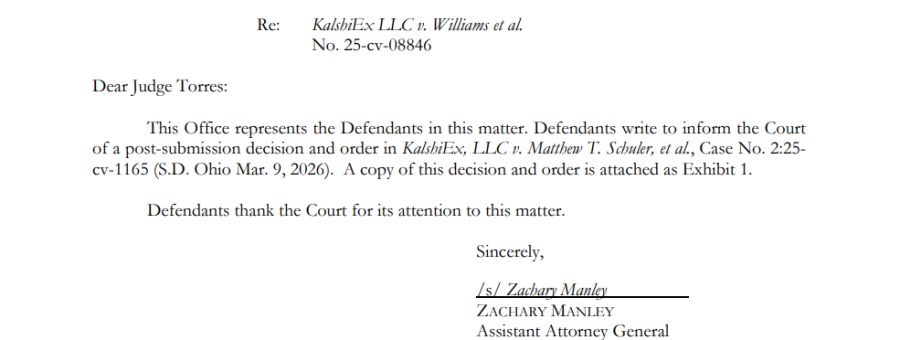
The legal fight is also spreading into other jurisdictions. On the same day as the Ohio decision, the New York Attorney General’s Office notified a federal judge in Manhattan of the ruling, filing it as supplemental authority in its own case against Kalshi.
Featured image: Kalshi / Canva