A Minnesota Senate committee has moved forward a bill that would ban online “sweepstakes” casino-style games, setting up a wider fight over how the state should handle a fast-growing corner of digital gambling.
Senate File 4474 cleared the Senate Commerce and Consumer Protection Committee after a March 24, 2026 hearing. The proposal now heads to the Senate Judiciary Committee as lawmakers continue to weigh its impact.
It focuses on platforms that use what lawmakers describe as a “dual-currency” system. Under the language, that means a setup where someone can take part in simulated gambling while paying some form of consideration and becoming eligible for “a prize, award, cash, cash equivalent, or chance to win a prize.”
It also defines an “online sweepstakes game” as any online or mobile product using that system while it “simulates casino-style or another form of gambling.”
Minnesota committee considers sweeping sweepstakes prohibition
The prohibition itself states that “a person or entity is prohibited from operating, conducting, or promoting an online sweepstakes game in Minnesota.”
The measure also blocks a wide list of companies tied to the industry, including any “applicant, licensed entity, financial institution, payment processor, geolocation provider, gaming content supplier, platform provider, or media affiliate.”
In effect, the bill aims to cut off both the games and the support network behind them.
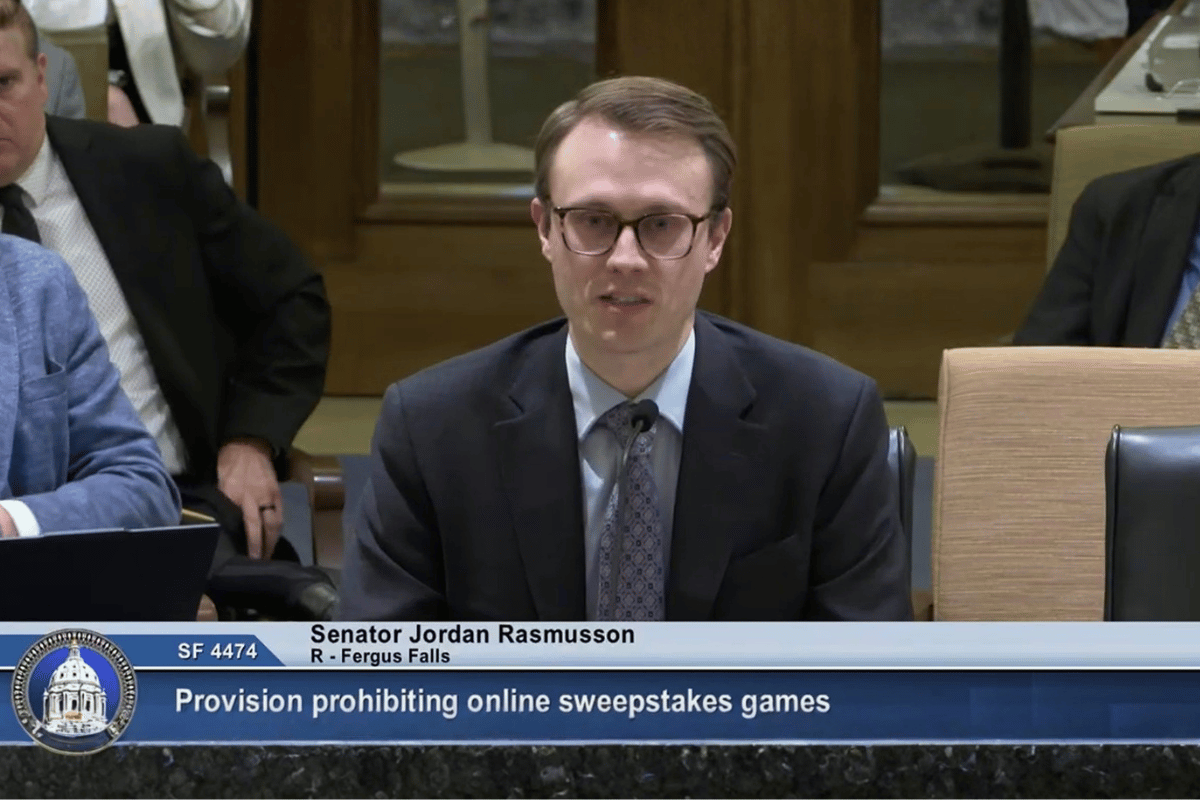
Sen. Jordan Rasmusson introduced the legislation earlier in March with bipartisan support from Sens. John Marty, Erin Maye Quade, Warren Limmer, and Matt Klein. Legislative summaries describe it as an “online sweepstakes games prohibition provision.”
During the hearing, Rasmusson said the goal is to draw a clearer line around what qualifies as a legal sweepstakes.
“Today, Minnesota, like many states, allow sweepstakes as a promotional marketing tool,” Rasmusson said, pointing to examples like McDonald’s Monopoly. But he said some companies are “using Minnesota sweepstakes law to effectively offer online gambling.”
He walked lawmakers through how the model works, describing systems where players buy “gold coins” and receive bonus “sweeps coins,” which he said “can be played for real cash prizes” on games such as “slots, blackjack and roulette.”
“The bill before the committee would clarify what is a sweepstakes, what is a proper sweepstakes in Minnesota, and it would ban dual currency online sweepstakes games,” he said.
Rasmusson also clarified what would remain legal. “To be clear, it would not ban social casino games,” Rasmusson said. “Minnesotans that want to play a social casino game for free … they’re not putting money in, they’re not winning prizes on the back end, they would still be able to do that.”
Supporters argue sweepstakes games resemble unregulated gambling
Supporters of the bill told lawmakers the games operate like gambling, regardless of how they are labeled.
Andy Platto, executive director of the Minnesota Indian Gaming Association, said sweepstakes casinos “use a deceptive dual currency model to claim legality,” adding that “these are casinos for real money without any authorization from the state.”
Committee materials made a similar case, describing the platforms as products that “look and feel like traditional casino games” including “slots, blackjack, craps, scratch-offs, bingo and more,” and rely on payment, chance, and prize.
Charitable gambling groups also raised concerns about lost revenue. Tim Engstrom of the American Legion Department of Minnesota said hundreds of local posts rely on gambling funds.
“I want to kind of point out that this isn’t that confusing as people are making it out to be,” Engstrom said. He compared the setup to charging for a sandwich wrapper instead of the sandwich, saying companies are “trying to get around the consideration of gambling.”
He added that the platforms do not contribute tax revenue and lack clear assurances of “fairness” or transparency about “what your wager’s supporting.”
Rasmusson said support for the bill spans tribal organizations, charities, and anti-gambling groups. He described that backing as “broad concern” and said stakeholders are “asking that this loophole be close[d].”
Gambling industry warns of unintended consequences
Industry representatives pushed back, arguing the bill goes too far and could create new problems.
Patrick Fechtmeyer, founder and CEO of ARB Interactive, said his company operates within the law and owns the Publishers Clearing House brand, which he said has “more [than] 70 years of lawful sweepstakes experience.”
He told lawmakers that “participation in our sweepstakes is always free with clear alternate methods of entry in compliance with state law.”
Fechtmeyer argued that banning the model would not reduce demand, adding “instead, [it will] push Minnesotans to the more than 1,100 offshore operators who hide behind shell companies [and] don’t comply with consumer protections or sweepstakes laws.”
He argued that companies like his invest in “age verification, geo-location compliance, consumer protections” and would leave the state if the bill becomes law, “leaving consumers completely unprotected and vulnerable.”
He also called for a different approach. “Minnesota has a real opportunity here not to react but to lead,” Fechtmeyer said, urging lawmakers to wait and work toward “a thoughtful, balanced solution.”
Lexi Morgan of the Social Gaming Leadership Alliance (SGLA) also opposed the bill. She said the group represents “the largest, most established and most innovative companies in the social plus industry,” with some operating in Minnesota “for well over a decade.”
Morgan said her organization supports updated rules but not a ban. “We do believe that Minnesota sweepstakes laws should be updated for the digital age to provide further guardrails,” she said, adding that the industry favors “a regulatory and taxing framework which could generate significant revenue for the state.”
She also disputed a key claim from supporters. “No money or consideration is ever required for a player to enter the sweepstakes,” Morgan said, noting that “more than half of the participants never spend money to play these games.”
Morgan also pointed to timing, saying the bill was introduced only days before the hearing and that there had not been enough time for “this nuanced discussion.”
Broader questions remain unresolved
The discussion around SF 4474 quickly expanded beyond sweepstakes games alone, touching on the bigger picture about gambling policy in Minnesota.
Sen. Matt Frentz said, “Sounds to me like we want to eliminate illegal gambling in the state of Minnesota,” while also calling for a “larger conversation” about sports betting, sweepstakes, and prediction markets.
He said lawmakers need to balance competing priorities: “kick out illegal gambling, provide what the people [are] looking for, protect our veterans and their veterans organizations, [and] honor our promises to those tribes.”
Rasmusson said he has met with stakeholders on all sides. He told the committee he had spoken with “every single group that has requested a meeting on this bill, including opponents testified against [the] bill today,” and said those conversations would continue.
In closing, he added: “What we’re trying to do [is] ensure that legitimate promotional sweepstakes can continue [in] the state of Minnesota, closing a loophole that’s effectively allowing online gambling.”
The bill also outlines how it would be enforced. It directs the commissioner of public safety and the attorney general to block businesses from operating if they or their affiliates accept revenue “directly or indirectly derived from an online sweepstakes game.”
The provisions show that enforcement could reach beyond operators to the companies that help run or support the platforms.
Featured image: Screenshot from Minnesota Committee on Commerce and Consumer Protection