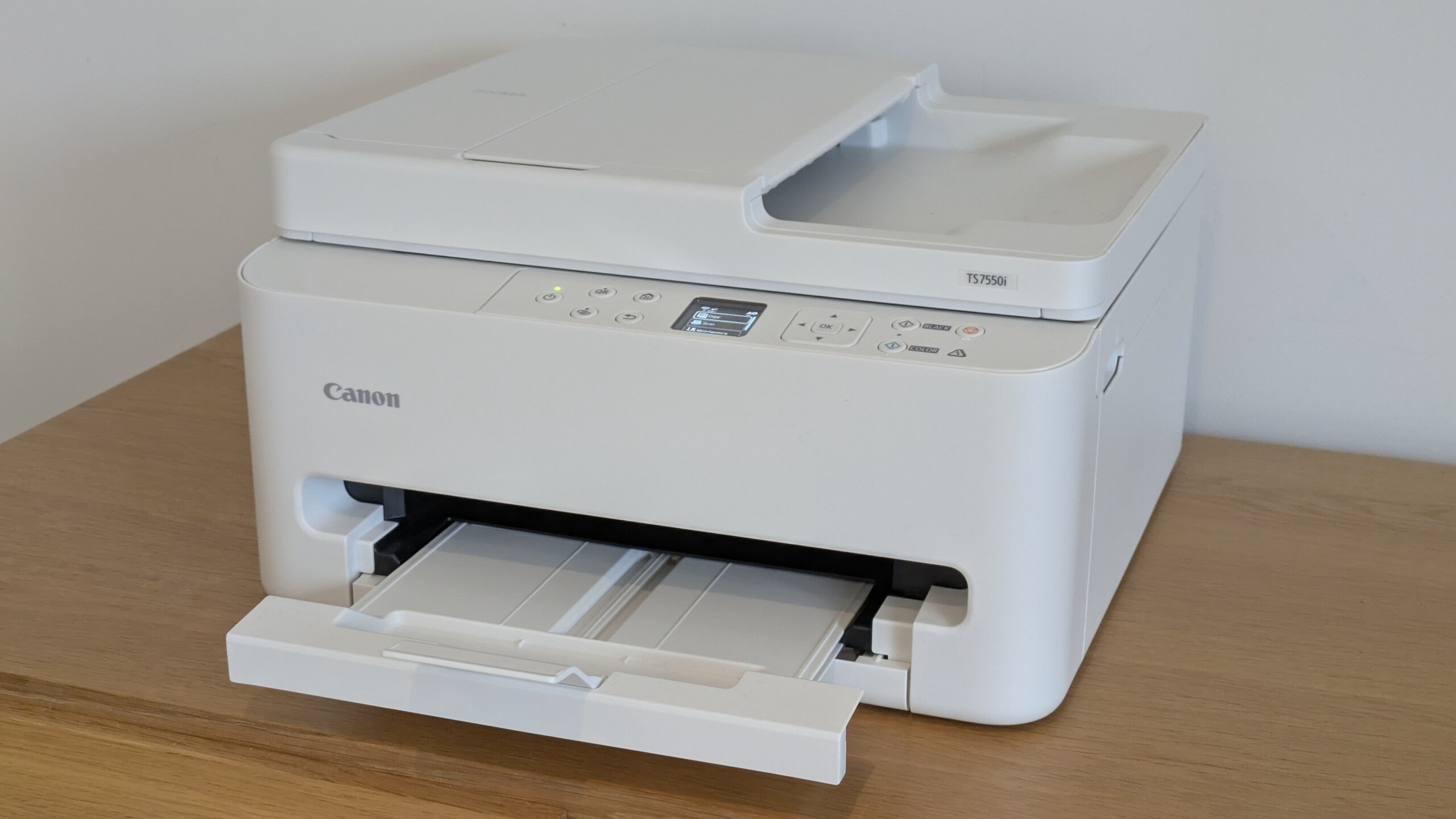
Verdict
The PIXMA TS7150i is that rarest of things; a Canon inkjet multifunction that we don’t particularly like. While there’s not much wrong with its print quality, and the automatic document feeder on top is certainly handy, it’s not much of an improvement on cheaper models in the range. Unfortunately, it also comes with high running costs. For all but the lightest of use, the Canon PIXMA TS7550i is probably a multifunction to avoid.
-
Fairly good set of features -
Excellent print and scan quality
-
Not particularly quick -
Very expensive to run
Key Features
-

Review Price: £85 -
A three-in-one wireless MFP
This three-in-one multifunction peripheral can print, scan and copy, but there’s no fax support. You can share it over a wireless network, and print on both sides of a sheet of paper, too. -
Automatic document feeder
The Canon PIXMA TS7550i has an automatic document feeder (ADF), ideal for multi-page copies and scans. It can’t capture both sides, though, so the MFP won’t make automatic double-sided copies.
Introduction
The Canon PIXMA TS7550i is one of a batch of three new closely related inkjet multifunction peripherals (MFPs) released by the Japanese manufacturer. It sits above the similar TS6550i, and below that the Canon PIXMA TS4150i.
All three are quite similar, being based on essentially the same inkjet printer and scanner combo. While the TS4150i is comparatively basic, the TS6150i adds a screen and some subtle upgrades, while the TS7550i reviewed here also has an automatic document feeder (ADF), allowing it to make multi-page copies and scans.
While it’s common for manufacturers to release related printers, it certainly helps if the underlying hardware is strong.
Can a medium to high-end home inkjet really deliver if it’s based on the same internals as a budget model?
Design and Features
- Underwhelming design
- Fairly good features
- Very expensive to run
I’m not particularly enamoured with the design of the Canon PIXMA TS7550i. Its beige-adjacent, off-white panels are a long way from the high-gloss black you might have found on the equivalent PIXMA 10 years or so ago.
As I mentioned, it’s quite similar in specifications to the cheaper TS4150i, which means you get only a single 100-sheet paper input, although like the TS4150i this MFP does come with duplex (double-sided) printing.

While I like the retro aesthetic of the TS7550i’s small white-on-black display, it’s not quite as useful or intuitive as the best colour screens – let alone a large colour touchscreen. Still, this isn’t an especially expensive device, so it seems a sensible compromise. For the most part, this Canon menu system is easy to use and fairly well featured.

That’s generally true of the Canon PIXMA TS7550i itself. It supports dual band Wi-Fi, so you should be able to share it reliably on the typical home network. Its ADF is likely to prove handy, too, especially if you’ll sometimes need to scan or copy longer documents. One thing to mention here is that, unlike the printer itself, the ADF can only scan one side at a time – that means you can’t make automatic double-sided copies, or scans of double-sided documents.
The TS7550i costs around £20 more than the TS4150i. This gets you upgrades, including the screen and ADF, which seems fair enough, but this model uses the same ink cartridges as its more affordable siblings, and that’s a bit of a problem. The two cartridges – one for black ink, and a combined one for cyan, magenta and yellow – are available in two sizes, but whichever you choose, running costs work out high.
Calculated for the standard items, which should print around 180 pages, each full-colour page will set you back a huge 22.3p. You can usually reduce print costs by opting for the high-yield alternatives. Here these last 300 pages each, but only cut the cost per page to 17.8p. Most significantly, almost half (8.6p) of this is contributed by black ink, so text printing will still be unusually expensive.

Fortunately you can sign this printer up for a Canon PIXMA Print Plan, which lets you choose from a range of monthly print volumes for a fixed fee – the TS7550i will order ink when it needs it. However, even the best value of these works out at 4.5p per page.
That’s great value for full colour pages or photos, but still higher than ideal for black text. I should also point out that getting this optimum value depends on using exactly your page allocation each month. Go over, or fail to use up the full quota, and the cost per page creeps up.
Print speed and quality
- Not especially fast
- Excellent print and scan quality
- Decent photos
One other feature that the Canon PIXMA TS7550i shares with its cheaper siblings is that it’s not especially fast. However, while that’s OK on the more affordable models, it’s a little less so on this higher-end device. Fortunately it’s not exactly slow; it could deliver a first page of black text in 10 seconds, and print five pages in 27 seconds, a rate of 11.1 pages per minute (ppm). Over 20 pages it managed to hit 12.6ppm, not far off Canon’s 14.0ppm claim.
Inkjet printers in particular are always slower when printing colour graphics, and the TS7550i was no exception, managing a best of 6.3ppm over 20 pages. Still, this actually compares slightly better against competitors than the underwhelming text speeds. One oddity was that, despite it using the same cartridges with their embedded print heads, this printer was slower to print photos than the TS4150i. Again, however, its 131 seconds for a borderless A4 print remains quite competitive.

The Canon PIXMA TS7550i isn’t the most hurried scanner. It could preview a page in eight seconds, and go on to capture it at 150 dots per inch (dpi) in 15 seconds, both of which are fairly competitive. However, the same job needed 43 seconds at a more detailed 300dpi, while a 600dpi 6×4” (15x10cm) photo scan took 52 seconds – both a touch slow.

Photocopy speeds were also a bit of a mixed bag. While a single mono copy took only 13 seconds, and a 10-page ADF copy completed in a minute and a half, the equivalent colour jobs needed 21 and two and half minutes respectively.
Here comes the good news: the results were uniformly very good or excellent. This MFP produced some of the best black text and colour graphics you’ll get from an inkjet, and made a decent job of photos, too. I was impressed by its crisp office document scans, and quite happy with its efforts on high-resolution photos. Photocopies were strong, too.
Should you buy it?
Buy if you print very little
If you don’t print much and you want a home all-rounder, the PIXMA TS7550i will deliver strong results. It’s particularly good at printing colour graphics on plain paper.
Don’t buy if you’ll print a lot
Even with an ink subscription, this isn’t an especially cheap MFP to run. Look elsewhere if you’re likely to print in moderate or high volumes, or if you’re not prepared to commit to a monthly fee.
Final Thoughts
I’ve been reviewing the best printers long enough to remember when the first PIXMA models launched. The sub-brand quickly became known for its generous features and cool designs, so the Canon PIXMA TS7550i has left me wondering what happened. It’s not a bad MFP, delivering some excellent results, but it doesn’t offer up any surprise or delight. At this price it’s not really fast enough, either.
But as with the cheaper TS4150i, this MFP’s main issue is very high running costs – particularly for black-only pages. Yes, you can save money by subscribing to a PIXMA Print Plan, but it’s a shame you effectively have to – buy your own cartridges and the running costs are just too high to stomach.
FAQs
Generally speaking there isn’t one – Canon makes several excellent printers and multifunction devices. We don’t think the PIXMA TS7550i is one of them, but it’s a rare misstep from a company that usually makes great kit.
Where a printer has a screen, we usually resort to the old-school method of using the network settings menu to manually scan for and join a network. This can be a pain without a touch screen, as you usually need to scroll through a big list of characters to enter your password.
It’s often quicker and easier to use Wi-Fi Protected Setup (WPS), although you may need to refer to the printer’s manual, and your router’s documentation if you’re not familiar with how this works.
Typically, the easiest route is to use the manufacturer’s smartphone app to search for and add the printer to the network. You should then find that any PCs or other devices can access it.
Test Data
| Canon PIXMA TS7550i | |
|---|---|
| Energy consumption | 23 Watts |
| Printing A4 mono speed (single page) | 10 sec |
| Printing A4 mono speed (5 pages) | 27 sec |
| Printing A4 mono speed (20 pages) | 95 sec |
| Printing A4 colour speed (single page) | 14 sec |
| Printing A4 colour speed (5 pages) | 51 sec |
| Printing A4 colour speed (20 pages) | 188 sec |
| Scanning speed test (single page) | 15 sec |
Full Specs
| Canon PIXMA TS7550i Review | |
|---|---|
| UK RRP | £84 |
| USA RRP | Unavailable |
| EU RRP | €95 |
| CA RRP | Unavailable |
| AUD RRP | Unavailable |
| Manufacturer | Canon |
| Quiet Mark Accredited | No |
| Size (Dimensions) | 374 x 355 x 208 MM |
| Weight | 6.3 KG |
| ASIN | B0FPDBQ69P |
| Release Date | 2025 |
| First Reviewed Date | 12/12/2025 |
| Model Number | 7178C013 |
| Ports | USB |
| Connectivity | 802.11a/b/g/n wireless (dual band) |
| Ink Cartridge support | PG-595 black, CL-586 colour (300 pages each) |
| Printer Type | Colour |
| Scanner? | Yes |
| Ink Type | Cartridge |