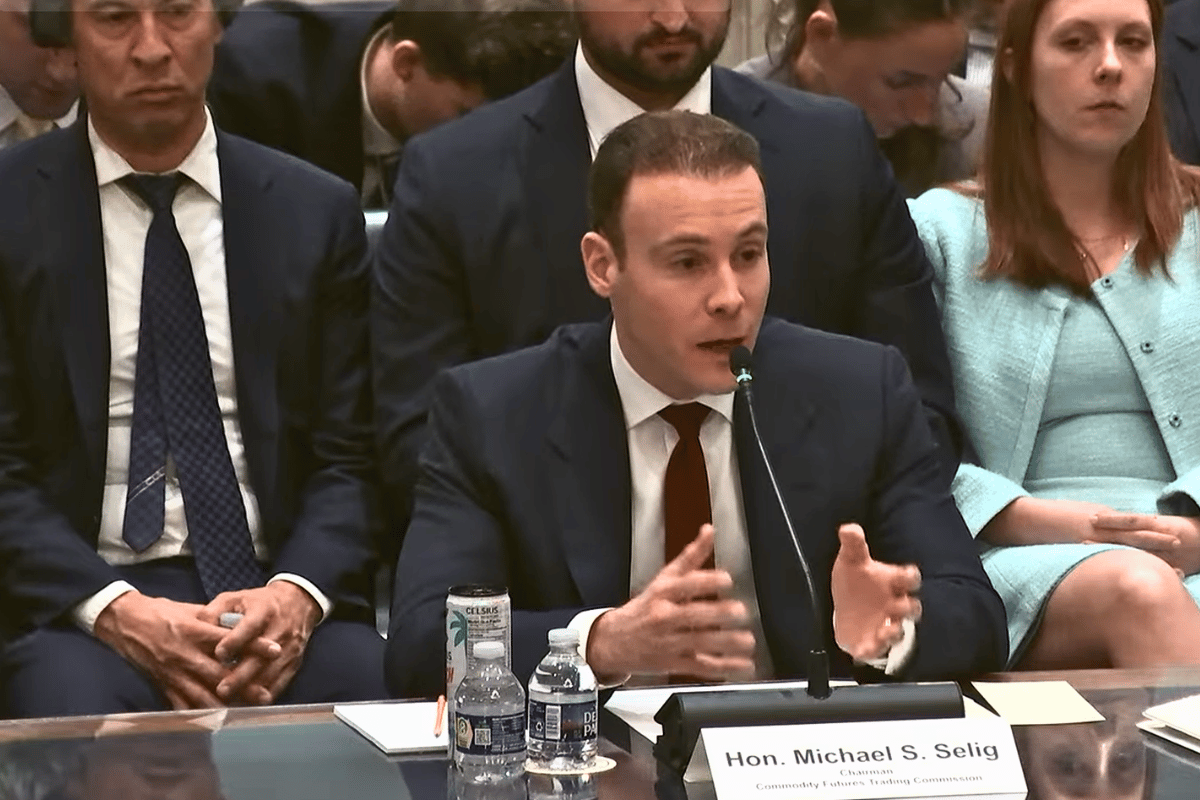
The Commodity Futures Trading Commission (CFTC) came to the House Agriculture Committee on Thursday (April 16), hoping to talk about market integrity and fraud. Instead, it got dragged into the much messier question hanging over prediction markets, i.e. when does a “financial product” start looking suspiciously like a sportsbook in a blazer? The answer, judging by the CFTC hearing, is right about the moment lawmakers start saying “Jose Altuve home run prop” out loud.
The tension has been building for months. The CFTC has been pushing new guidance and a formal rulemaking process for prediction markets even as the larger fight over whether these contracts are legitimate exchanges or just gambling with better stationery keeps escalating. At the same time, Kalshi has been expanding deeper into sports-style offerings, including contracts on touchdowns, point spreads and total scores, pushing the industry closer to the exact kind of betting state and tribal regulators say is already heavily regulated for a reason.
Rep. Gabe Vasquez argued that prediction markets and sportsbooks may be sold under different labels, but the average user may not notice the difference.
“The odds are functionally the same,” Vasquez said, and “consumers couldn’t care less if they’re using an official sports book or engaging with a prediction market.” That was less a question than a blunt summary of the political problem now facing the CFTC.
Tribes say they played by the rules. Prediction markets may not have
Vasquez then made the tribal-sovereignty argument in unusually concrete terms. Tribes and states, he said, spent decades building gaming systems with “compacts, licensing, integrity rules, age verification, and consumer protection.” So when a federal regulator allows prediction markets to operate outside that structure, he said, “it undermines tribal sovereignty and state protection.” He pointed to the Pueblo of Laguna and said communities are losing revenue that helps pay for “childcare, education, infrastructure, and the overall well-being of their community.”
This appears to line up with the legal and political fight now underway across the country. Twenty-seven states have backed tribal appellants in a federal case against Kalshi, and we previously reported that tribes argue federally regulated prediction markets threaten the compact-based structure created under the Indian Gaming Regulatory Act.
Tribal gaming experts who spoke to us said prediction markets are pushing into territory long governed by state-tribal arrangements, while Indian Gaming Association Chairman David Z. Bean called them “an attempt to bypass tribal authority and recast gambling as a financial product.”
Then Vasquez delivered the line that seemed to sum up the hearing’s conceptual headache. “Airlines hedge fuel costs, farmers hedge crop prices—that is very different from putting money on the outcome of a baseball game,” he said. He asked whether a market on “whether, as an example, Astros second baseman Jose Altuve hits a home run in tonight’s game against the Rockies” hedges “any real economic risk.”
CFTC Chairman Michael Selig did not exactly grab that hanging curveball and smash it into the gap. “Congressman, there are many risks that could be hedged through various contracts in our markets,” he replied. “The bottom line is that these markets need to be well-functioning and comprehensively regulated by the CFTC. Our statute mandates it and we’ll continue to do it.”
In a recent Wall Street Journal op-ed, Selig argued that prediction markets are not gambling but federally regulated event contracts with a “legitimate economic function,” and as we stated, the CFTC’s filing of a friend-of-the-court brief supporting Crypto.com in Ninth Circuit litigation. The awkward part for Selig is that these lofty hedging arguments now have to coexist with the fact that firms are offering products that look an awful lot like sports wagers with the serial numbers filed off.
CFTC prediction markets hearing sparks corruption clash
The hearing got even pricklier when Rep. Jim McGovern brought politics into it with a shovel rather than a spoon. McGovern noted that “the president’s son is on the board of both multi-billion dollar prediction market companies,” then added, with all the subtlety of a brick through a window, “it seems to me like the only reason two competing companies hired the same person is because they think he must be really, really, really valuable.”
There is at least some factual foundation for the political line of attack. In August 2025, Donald Trump Jr. joined Polymarket’s advisory board and also invested in the company via 1789 Capital. Trump Jr. is also an adviser to Kalshi, while Kalshi board member Brian Quintenz was nominated as Trump’s pick to head the CFTC, before Selig was confirmed.
So McGovern asked the question everybody in the room knew was coming: “has anybody in the White House ever asked or insinuated that you should drop the CFTC’s probe into Polymarket?” Selig snapped back that “we treat all market participants alike,” that the agency does not “pick winners and losers,” and that “it’s insulting that you’re insinuating that we would play political games.”
McGovern, unmoved, replied: “No, I’m wary because it smells like corruption. I’ll be honest with you.” Once a hearing gets to “smells like corruption,” nobody is really pretending it’s a routine oversight session anymore.
One commissioner, no problem, says one commissioner
There was also the small matter of whether the CFTC is actually staffed to referee all this. Reuters reported that Selig testified while serving as the only sitting member of what is normally a five-member commission, and said the agency would not wait for the other four seats to be filled before issuing new regulations. “We cannot, for the sake of the American people, slow down in our rulemaking,” he said. The news outlet also noted the CFTC is overseeing an increasingly complex set of markets, including futures, swaps, event contracts and likely a bigger digital-assets role.
Selig nonetheless tried to wave away concerns about capacity. He told Rep. Shontel Brown that “a lot of that fake news out there about us being under-resourced is incorrect,” adding: “There are certain vacancies that we are filling. That does not mean that we don’t have the resources and staff to fulfill our mission.”
However, in February that five Democratic senators said they were “deeply concerned” that the CFTC’s Chicago enforcement office had shrunk from 20 enforcement attorneys to none, and asked for answers on vacancies, staffing levels and whether resources were being shifted to preserve enforcement strength.
Put all of that together, and Thursday’s hearing looked less like a clean debate over market structure and more like a stress test for the CFTC’s entire theory of prediction markets.
Lawmakers are saying the products look like sports betting. Tribes and states are saying they blow a hole through long-settled gaming law. Critics are flagging political connections. And Selig, alone on a five-seat commission, is insisting that everything is under control and the referee still has the whistle.
That may be true. But on Thursday, Capitol Hill sounded unconvinced — and more than a little annoyed that the nation’s most fast-growing “financial innovation” keeps looking like gambling wearing a lanyard.
Featured image: House Committee on Agriculture via YouTube